


Newsela launched in 2013 with a bold mission: Meaningful classroom learning for every student. Today, our team constantly strives to deliver powerful solutions that inspire our users.
5 Things to Consider When Planning AI Adoption at Your District: An Evaluation Guide
July 31, 2025
Pillar: AI in Schools
Navigate the AI inflection point with a purposeful evaluation framework
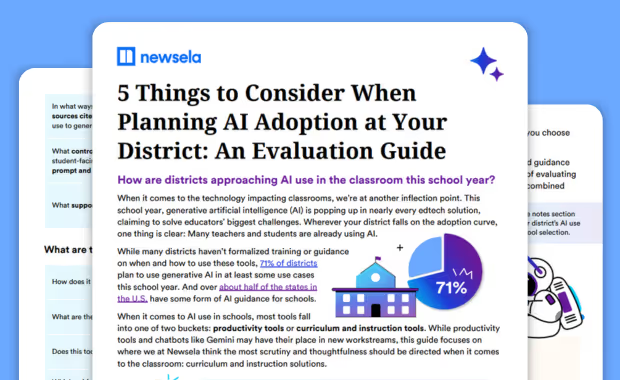
Evaluate AI-powered curriculum and instruction tools with a framework designed to move your district from hype to impact. This guide provides a synthesized look at pedagogical and technical considerations to help you choose solutions that support learning goals, provide scaffolded texts, and drive meaningful student outcomes across K–12 grade levels.
5 Core Pillars of AI Evaluation
Student Outcomes
Aligning AI to learning objectives and standards.
Ease of Use
Minimizing steps for teachers and students.
Specific Pain Points
Solving for differentiation and time-savings.
Equitable Access
Ensuring accessibility and minimizing bias.
Data Privacy
Compliance with FERPA, COPPA, and safety.
Strategic Advantages
Ensure pedagogical alignment by selecting AI tools that enhance deeper thinking rather than automating basic tasks.
Leverage research-backed selection criteria synthesized from organizations like Common Sense and Digital Promise.
Drive data-informed instruction using AI to gather student insights and adjust instruction in real-time.
Implement responsibly by vetting content sources and training models for classroom-readiness and accuracy.
5 Things to Consider When Planning AI Adoption at Your District: An Evaluation Guide
Pillar: AI in Schools
Navigate the AI inflection point with a purposeful evaluation framework
Evaluate AI-powered curriculum and instruction tools with a framework designed to move your district from hype to impact. This guide provides a synthesized look at pedagogical and technical considerations to help you choose solutions that support learning goals, provide scaffolded texts, and drive meaningful student outcomes across K–12 grade levels.
5 Core Pillars of AI Evaluation
Student Outcomes
Aligning AI to learning objectives and standards.
Ease of Use
Minimizing steps for teachers and students.
Specific Pain Points
Solving for differentiation and time-savings.
Equitable Access
Ensuring accessibility and minimizing bias.
Data Privacy
Compliance with FERPA, COPPA, and safety.
Strategic Advantages
Ensure pedagogical alignment by selecting AI tools that enhance deeper thinking rather than automating basic tasks.
Leverage research-backed selection criteria synthesized from organizations like Common Sense and Digital Promise.
Drive data-informed instruction using AI to gather student insights and adjust instruction in real-time.
Implement responsibly by vetting content sources and training models for classroom-readiness and accuracy.