


Share First Day of Fall Activities for ELA and Science

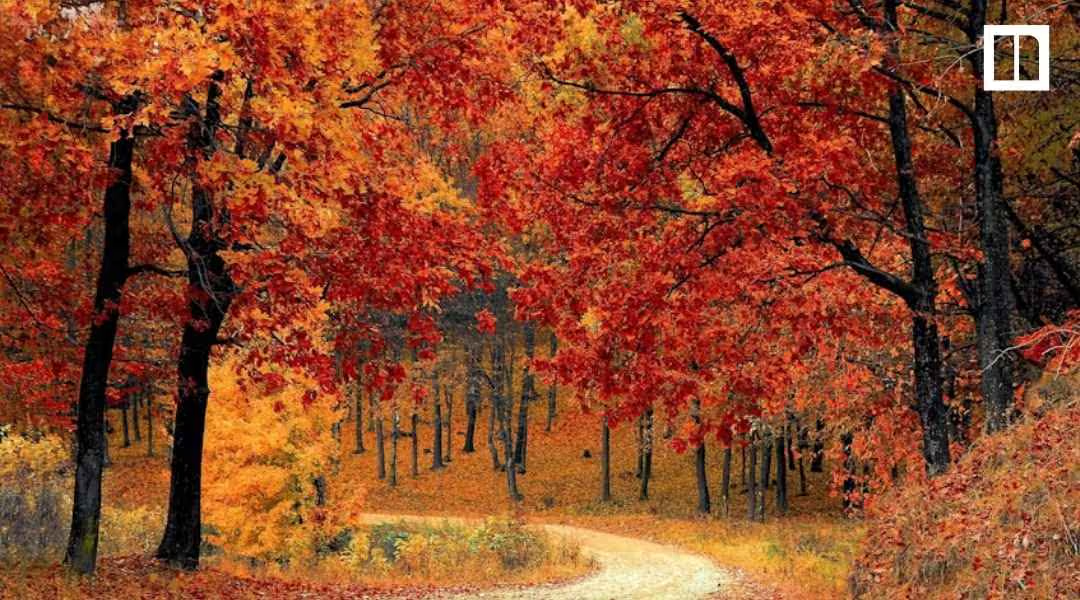
Autumn forest path with red and orange fall foliage for a Newsela blog about first day of fall activities.
August 23, 2026

The first day of fall is a timely (and easy!) way to bring seasonal lessons into the classroom and tie them to concepts and phenomena students already recognize. Changing leaves? Shorter days? Fall sports? All engaging.

These first-day-of-fall activities turn that interest into ELA and science conversations and don’t require you to build brand new units from scratch. 

[Explore first day of fall science activities](id-sci)

Key Takeaways

  • Start with the season students can see: The first day of fall gives you a natural launch point for questions about seasons, sunlight, leaves, ecosystems, and weather.
  • Match the activity to the evidence you need: A write prompt, leaf lab, decomposer model, or data task can show student thinking in different ways.
  • Keep the lesson flexible: Articles, videos, datasets, and hands-on activities let you choose a fall science resource that fits your grade band and available time.

Start with the seasonal changes students already notice, like shorter days, cooler weather, and colorful leaves. Then turn them into science questions about sunlight, ecosystems, and weather.

What causes the seasons?

Seasons happen because Earth tilts as it orbits the Sun. This changes how directly sunlight reaches different parts of the planet. Use this first day of fall activity to help students surface, test, and correct the common misconception that seasons happen because Earth moves closer to or farther from the Sun.

Activity sequence: What causes the seasons?

Recommended for upper elementary and middle school, this 45- to 60-minute activity helps students use the fall equinox to test a misconception, read for evidence, and revise their explanation of seasonal change.

Focus prompt

What causes the seasons? Feel free to take your best guess.

Warm-up

Collect the misconception first

Have students answer before they read so you can see whether they connect seasons to Earth’s tilt, changing sunlight, or Earth’s distance from the Sun.

Activity

Use the full seasons activity

Open the Newsela activity sequence when you want the prompt, article, write prompt, and extension in one place.

Open the activity

Anchor article

Read for the core explanation

Use “Big Questions: What causes the seasons?” to help students identify evidence about Earth’s tilt and sunlight.

Read the article

Visual evidence

Show how tilt changes sunlight

Add the tilt explainer when students need a clearer visual model for why sunlight changes across seasons.

Open the explainer

Comparison text

Compare the hemispheres

Use the hemisphere article to help students see that seasonal patterns depend on where you are on Earth.

Compare seasons

Synthesis

Revise the explanation

Have students return to their first answer and revise it with evidence. For an extension, ask them to define aphelion and perihelion, then explain why those terms do not prove that distance from the Sun causes the seasons.

How can a leaf chromatography lab introduce fall science?

A leaf chromatography lab turns a known fall observation into an investigation students can test. Start with the hands-on activity, then use the supporting multimodal content to help students connect hidden leaf pigments, seasonal color changes, and the fall equinox.

Newsela STEM activity

Explore why leaves change color

Use the leaf chromatography activity as the hands-on anchor, then choose a supporting article or video to help students explain what they observed.

Resource Use it to Reading level / runtime Spanish?
Find the hidden color of leaves Activity Start the investigation with a hands-on chromatography activity. 710L
Big Questions: Why do leaves change colors? Article Help students explain the science behind seasonal leaf color changes. 330L–1000L Yes
To survive wintertime, trees ditch those brilliant leaves Article Connect colorful leaves to how trees prepare for winter. 400L–1000L Yes
Why do leaves change colors in the fall? Video Use a short visual explanation before the lab or as a recap after students observe their results. 2:58
Goodbye summer: Fall equinox marks the first day of autumn Article Connect the leaf-color investigation to the seasonal timing of the fall equinox. 400L–1010L

Scroll left to right to see the full table.

Where do fallen leaves go after autumn?

Fallen leaves do more than pile up and disappear. They become part of a decomposition process that moves matter through an ecosystem. Use this activity to help students investigate decomposers, model how matter moves between living things and the environment, and connect an everyday fall observation to life science.

Newsela STEM activity

Investigate where fallen leaves go

Students model how decomposers break down fallen leaves and move matter through an ecosystem.

Question Why do leaf piles disappear?
Task Build a decomposer model
Standard NGSS 5-LS2-1
Concept Energy and matter
Resource Type Reading level / runtime Spanish?
Soils and nutrient cycling in the rain forest Article 600L–1370L Yes
Recycling the dead: how things decompose Article 410L–910L
Good news: You don’t need to rake your leaves; experts explain why Article 580L–1250L
The dirt on decomposers Video 3:18

Scroll left to right to see the full table.

How can football data bring fall sports into science class?

Use students’ interest in fall sports to get them working on data analysis. They can explore football physics data, look for patterns, then connect what they notice to articles about different aspects of the game. It’s a perfect fit for upper elementary and middle school students.

Newsela STEM activity

Analyze football physics data

Students explore football helmet data, look for patterns, and connect their findings to related sports science texts.

Resource Use it to Reading level / runtime Spanish?
Football Physics Deck by Tuva Dataset Introduce grouping, ordering, and data exploration before students move into Plot View.
Football Physics Dataset by Tuva Dataset Have students explore helmet data on their own or with the guided worksheet.
Researchers reveal the secret to the perfect football throw Article Connect football to physics, motion, and evidence from research. 510L–930L
Opinion: It’s time to end football in high school Article Invite evidence-based discussion about football safety and student athletics. 580L–1400L Yes
Can extra padding make football helmets safer? Article Pair the dataset with a text that explores helmet design and safety questions. 700L–1300L
Dream Jobs: Professional football player Job Profile Add a career connection for students interested in the sport. 360L–950L
How to analyze and interpret data Explainer Support students who need a refresher on reading and interpreting datasets. 480L–960L

Scroll left to right to see the full table.

Which Generation Genius science videos fit fall lessons?

Generation Genius videos work well when you want a ready-to-use fall lesson without building everything from scratch. Each video includes lesson supports, student-facing guides, vocabulary, discussion prompts, DIY activity guides, and Formative-powered assessment options.

Generation Genius videos

Pick a fall-ready science video by grade band

Use these videos to support lessons on seasons, weather, the Sun, and Earth systems.

Video Grade band Runtime
Four Seasons and Day Length K–2 11:05
Introduction to Weather K–2 12:02
Heating and Cooling K–2 10:42
Earth’s Orbit & Rotation 3–5 11:16
Sun and Other Stars 3–5 10:55
Weather vs. Climate 3–5 12:41
Causes of Seasons 6–8 14:02
Air Masses & Weather Fronts 6–8 14:26

Scroll left to right to see the full table.

[Use first day of fall ELA activities](id-ela)

Key Takeaways

  • Seasonal texts still need a skill focus. Choose poems, fiction, and articles that help students practice close reading, summary, and genre awareness.
  • Pair texts with a purpose. A Venn diagram or paired text analysis worksheet gives students a clear structure for comparing ideas, text structure, and author’s purpose.
  • Use interest as the hook. Fall topics can make annotation, discussion, and evidence work feel connected to what students already notice outside class.

First-day-of-fall activities can support more than seasonal excitement. Use ELA texts to build genre awareness, close-reading habits, and evidence-based comparisons while students interact with multimodal content and supports.

What fall fiction and poetry can students read?

Use fall fiction and poetry to give seasonal reading a clear skills focus. Students can compare imagery, mood, structure, and point of view across genres. 

Newsela ELA resources

Choose fall poems and fiction by grade band

Open each grade-band group to find seasonal texts for close reading, author’s craft, mood, imagery, and genre conversations.

Elementary fall reads 7 resources
Resource Grade band Spanish?
“Gathering Leaves” By Robert Frost Poem 2–5
“Falling into Fall” By Carol H. Stewart Poem 2–5
“September” By Sharon Ruth Gill Poem 2–5
“Look Up!” By Karen G. Jordan Poem 2–5
Spring and Autumn: A Japanese Story By Angella McAlsister Fiction 2–5 Yes
Halloween’s scary fairies Article 2–5
The Very Wicked Witch and the Village Play By Mark Gartside Fiction 2–5 Yes

Scroll left to right to see the full table.

Upper elementary and middle school fall reads 5 resources
Resource Grade band Spanish?
“O Autumn, Autumn!” By Effie Lee Newsome Poem 4–8
“Autumn” By Alexander Posey Poem 4–8
“Nothing Gold Can Stay” By Robert Frost Poem 3–8
“Song For My City” By Jessica Kim Poem 3–8
“Halloween” By Arthur Peterson Poem 4–8

Scroll left to right to see the full table.

Middle and high school fall reads 4 resources
Resource Grade band Spanish?
“October” By Robert Frost Poem 4–12
“Autumn” By Emily Dickinson Poem 4–12
“The Sheaves” By Edgar Arlington Robinson Sonnet 6–12
“To Autumn” By John Keats Poem 9–12

Scroll left to right to see the full table.

How can students compare seasonal paired texts?

Students can compare seasonal paired texts by reading with a shared focus, annotating evidence, and using graphic organizers to explain how ideas connect.

Newsela ELA routine

Compare seasonal paired texts in four moves

Use this sequence to help students read two fall texts, annotate with purpose, and explain how the texts connect.

1
Preview the topic

Identify the topic or general idea, then ask students what they know, wonder, or predict.

2
Annotate by genre

Highlight story elements in fiction or key details and main ideas in informational text.

3
Turn and talk

Ask partners to share annotations and summaries before they move into comparison.

4
Compare the texts

Use a Venn diagram or paired text analysis worksheet to connect ideas, structure, genre, and purpose.

Comparison questions
  • What is the main idea of each text? How are the main ideas connected?
  • How are the ideas similar or different? Use details from each text.
  • What is the text structure of each text? How does structure connect to author’s purpose?
  • How do genre and style affect the author’s message?
Graphic organizers
Venn Diagram

Use it to sort similarities and differences between two texts.

Download the Venn diagram
Paired Text Analysis

Use it to answer one guiding question across both texts.

Download the analysis worksheet
Seasonal paired text sets
Paired text set How to use it
“Autumn” and Forestry Compare how a seasonal literary text and an informational text approach the same fall-connected topic.
“Autumn” and Adaptation Use the set to compare seasonal ideas, evidence, and author choices across two connected texts.
“Spring and Autumn” and the Changing Seasons Have students compare how two texts present seasonal change, then cite evidence from both texts.

Scroll left to right to see the full table.

Newsela Learning Suite

Plan your next seasonal lesson with Newsela

Build on students’ curiosity about fall with ready-to-use ELA, science, and cross-curricular resources that help you move from seasonal interest to meaningful instruction.

Newsela Lite Hero Hands

Everything you need to accelerate learning across ELA, social studies, and science

Create your free Newsela account

If you like this article...

Browse more educational and seasonal content from Newsela.
A black and white photo of a person wearing a winter coat, hat, scarf, and backpack, standing on a snowy path with their arms outstretched in celebration, viewed from behind.
Blog

Welcome a New Season With 9 Winter Solstice Activities

Bring a change in the seasons into your ELA and science classes with these engaging winter solstice activities for students.
A close-up shot of a single vibrant red tulip standing out in a field of white tulips under bright spring sunlight.
Blog

Happy First Day of Spring: Classroom Activities for You

Celebrate a happy first day of spring with science and ELA lessons that help you tap into students’ curiosity about seasons, weather, and change.
Bright sun shining in a blue sky with white clouds.
Blog

9 Summer Solstice Activities for Students

Explore summer solstice activities for ELA, social studies, and STEM to help students learn about seasons, culture, and summer.

Related resources

Explore more in-depth content on the education topics that matter in your schools and classrooms.
No items found.

Inspire the desire to learn.

Ready to engage, support, and grow every learner?