Diwali activities give your students a chance to explore the Festival of Lights through stories, cultural traditions, and investigations of light and color. Use these resources to compare literary and informational texts, explore South Asia cultures, and investigate the science and math connected to Diwali traditions.
Choose activities that fit your learning goals, whether you’re planning one lesson or connecting work across several classes.
[Practice literacy skills with Diwali ELA activities](id-ela)
Key Takeaways
-
●
Summarize before comparing. Have students identify each text’s key details and write a summary before looking for connections between the readings.
-
●
Video details reveal purpose, too. The grades 5–8 lesson uses two Diwali videos so students can compare what each creator includes and infer the creator’s purpose.
Diwali stories and informational texts give students different ways to explore the celebration through different lenses. Use these Diwali ELA activities to compare texts, write summaries, and examine how authors and video creators choose details for their audiences.
How can students compare traditional Diwali stories and personal experiences?
Pair a traditional Diwali story with a personal essay to help your students compare how writers describe the holiday. In this paired text lesson, students summarize each reading, then use evidence to explain how genre and perspective shape its message.
Compare two perspectives on Diwali
Pair
“Rama and Sita”,
a traditional Hindu story, with
a personal essay about celebrating Diwali in the United States.
Use
Diwali: The Hindu Festival of Lights
if students need background before reading.
Comparison questions
Choose a question to guide students’ annotations and discussion.
- Main idea: What idea or message does each text communicate? How are they connected?
- Details: What similarities and differences can you support with evidence from both readings?
- Structure: How does the organization of each text support its author’s purpose?
- Genre and style: How does each writer’s approach shape the message about Diwali?
Prepare and read
Annotate, then summarize
Before reading, ask students what they know about Diwali and what they want to learn.
During the story, have them highlight plot, setting, and character details.
During the essay, have them highlight details that establish the main ideas.
Students can use the annotation tool to summarize each text before comparing them.
Graphic organizer
Venn Diagram
Use this organizer to sort shared ideas and details unique to each reading.
Download Venn Diagram
Graphic organizer
Paired Text Analysis
Use this worksheet to organize evidence from both readings around your chosen comparison question.
Download Paired Text Analysis
Discuss and synthesize
Explain the connection
Have students turn and talk to share their summaries, then complete one organizer.
Ask partners to explain their response to the comparison question using evidence from both texts.
What can Diwali texts reveal about family and cultural traditions?
Pair fiction with nonfiction to help students connect a character’s family experience to real-world information about Diwali. In this paired text lesson, students examine how the story “Lilu’s Bright Diwali” brings traditions to life and how an informational text explains their history.
Explore Diwali through a family story
In
“Lilu’s Bright Diwali”,
a young girl wants to help her family prepare for the celebration.
Pair the story with
“History and significance of Diwali, the festival of lights”.
For additional background, use
Diwali: The Hindu Festival of Lights.
Comparison questions
Choose a question to connect the family story with the informational reading.
- Main idea: What does each text communicate about Diwali? How are its ideas connected to the other reading?
- Details: Which traditions appear in both texts? What does each reading add to your understanding?
- Structure and purpose: How does telling a story differ from explaining the holiday’s history?
- Genre and style: How do the character’s experiences and the article’s explanations shape each text’s message?
Prepare and read
Gather details from both genres
Ask students what they know about Diwali and what they predict the readings will explain.
In the story, have them highlight details about Lilu, her family, the setting, and the plot.
In the article, have them highlight details that establish each section’s main idea.
Students can use the annotation tool to write a summary of each reading.
Graphic organizer
Venn Diagram
Compare the traditions and details in both readings, including what each text explains on its own.
Download Venn Diagram
Graphic organizer
Paired Text Analysis
Organize evidence from the story and article to answer your chosen comparison question.
Download Paired Text Analysis
Discuss and synthesize
Connect a character’s experience to cultural context
Have partners share their annotations and summaries, then complete one organizer.
Ask students to explain how the informational text adds context to Lilu’s family experience,
using evidence from both readings.
How can students identify the author's purpose in Diwali videos?
Have students compare the details in two Diwali videos, then explain what those choices suggest about each creator’s purpose. This lesson applies the author's purpose analysis to media, with a Venn diagram to organize students’ observations.
01
Watch and notice
Ask what students know about Diwali and new-year celebrations.
Watch
“Diwali”
and
“Diwali festival celebration”.
Have students note what each video explains or shows about the holiday.
02
Compare and infer
Use a Venn Diagram to compare the details and types of information included.
Have partners discuss: What do those choices suggest about each creator’s purpose?
How are their purposes similar or different?
Download Venn Diagram
03
Write a video script
Ask students to compare Diwali with another holiday that shares some of its elements.
Have them write a video script and explain which details they’ll include to make the
similarities clear—and which they’ll leave out.
How do texts about tradition build connections across cultures?
Use the Traditions text set to help your students compare how people describe holidays across genres. Pair the Diwali explainer with another reading, then ask students to identify shared themes while explaining what makes each tradition unique.
Informational texts
7 resources
+
Scroll left to right to see the full table.
Fiction
1 resource
+
Scroll left to right to see the full table.
Poetry
3 resources
+
Scroll left to right to see the full table.
What can students learn from studying celebrations around the world?
Use the Celebrations Around the World text set to explore how holidays began and how people observe them today. Have your students compare Diwali with another celebration, using evidence to explain each holiday’s history, meaning, and customs.
Articles
6 resources
+
Scroll left to right to see the full table.
Explainers
5 resources
+
Scroll left to right to see the full table.
Photo resource
1 resource
+
Scroll left to right to see the full table.
[Explore Diwali and South Asian cultures in social studies](id-ss)
Key Takeaways
-
●
Connect decorations to their meaning. The Diwali lesson asks students to research a decoration’s significance and share their findings through an infographic and gallery walk.
-
●
Keep the geographic scope clear. Use the South Asia collection for regional comparisons and the India case study for a closer look at one country’s geography and culture.
Help your students explore Diwali’s history and customs, then connect their learning to geography, culture, and religion in South Asia. These social studies activities move from studying the celebration to examining the broader contexts that shape people’s traditions.
How do people celebrate Diwali?
People celebrate Diwali with lights, colorful decorations, food, and gifts. Use this Diwali social studies lesson to help your students connect those customs to the holiday’s meaning, then research a decoration and share what they learn in a gallery walk.
01
Write, pair, and share
Ask students: What comes to mind when you hear “Festival of Lights”?
What might the festival celebrate, and how might people observe it?
Have students write their ideas, discuss them with a partner, and share with the class.
Download Write-Pair-Share
03
Research a decoration
Have groups choose a Diwali decoration and research its meaning and importance.
Ask each group to create an infographic explaining what the decoration is
and why people use it.
Finish with a gallery walk so students can explore their classmates’ findings.
How can building background knowledge on Hinduism help students understand Diwali?
Use the Hinduism resource collection to give your students context for Diwali’s religious associations. Choose readings about beliefs, sacred texts, or deities based on the questions they have, then connect that background to the Diwali history explainer.
Beliefs and history
3 resources
+
Scroll left to right to see the full table.
Deity profiles
3 resources
+
Scroll left to right to see the full table.
Festivals and contemporary culture
4 resources
+
Scroll left to right to see the full table.
Explore more religious studies
Comparative Religions
Explore Judaism, Christianity, Islam, Dharmic religions, East Asian and Indigenous religions, and contemporary religious issues in Newsela’s social studies elective course.
Explore the course
How do religious beliefs shape cultural traditions in South Asia?
Use the South Asian cultural traditions text set to help your students explore connections between religious teachings and culture. Compare reading about Hinduism, Buddhism, and Sikhism, asking students to explain similarities and differences with evidence from the resources.
Hinduism
4 resources
+
Scroll left to right to see the full table.
Sikhism
2 resources
+
Scroll left to right to see the full table.
Buddhism
3 resources
+
Scroll left to right to see the full table.
World religions in historical context
1 resource
+
Scroll left to right to see the full table.
What can students learn about India’s geography and culture?
Students can explore how geography, history, religion, and daily life shape India’s diverse cultures. An eight-trait scavenger hunt helps them organize evidence from their readings, connect human activities to the environment, and explain their findings by creating a visual presentation.
Articles
7 resources
+
Scroll left to right to see the full table.
Explainers
6 resources
+
Scroll left to right to see the full table.
Biographies and country profile
3 resources
+
Scroll left to right to see the full table.
Video
1 resource
+
Scroll left to right to see the full table.
Culture scavenger hunt
Collect evidence across eight traits
-
Activate background knowledge:
List the eight traits of culture: government, religion, language,
art, history, social groups, daily life, and economy.
-
Read and annotate:
Choose two or three articles. Highlight examples of the traits,
using different colors when helpful. Label each example and
explain how geography might influence it.
-
Share evidence:
Compare annotations with classmates. Identify which traits your
readings helped you understand and which need more research.
Organize a comparison
For the lesson’s India–Pakistan comparison, write the eight traits
along the left margin of the Venn diagram and label the circles
“India” and “Pakistan.” Record evidence in the India section now,
then add the Pakistan evidence after studying that country.
Download the Venn diagram
Create a culture one-pager
Have students synthesize their research in a one-pager that includes:
- A clear, creative title.
- Important quotations or ideas from the readings.
- At least two visuals.
- Eight facts or ideas that help explain Indian culture.
- A reflection or personal connection.
Discuss the connections
- What examples of migration or population concentration did you notice? How did they influence culture?
- How did colonialism influence the cultural traits you explored?
- What factors shape your own culture? What similarities do you notice with the examples you studied?
[Investigate Diwali traditions with science and math activities](id-sci)
Key Takeaways
-
●
Diwali lamps connect naturally to physical science. Use diyas and other festival lights as a starting point for exploring fire, combustion, chemical change, light, and energy.
-
●
Videos and simulations can extend the science connection. Use them to investigate light and energy concepts that students can connect back to Diwali traditions.
-
●
Rangoli offers a clear math connection. Students can examine shapes, symmetry, angles, patterns, and transformations in traditional designs.
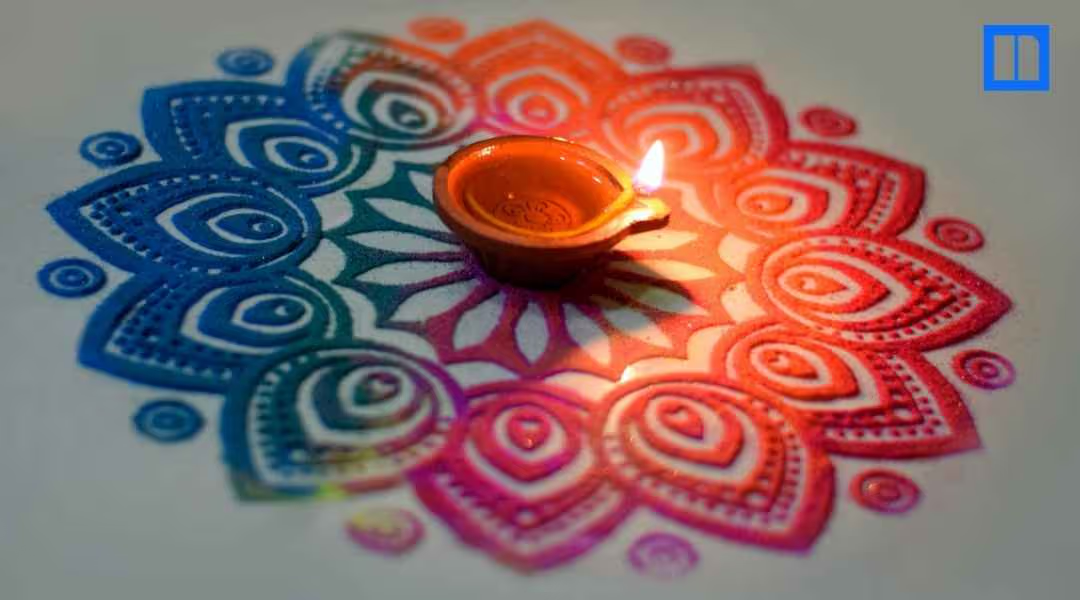
Some Diwali traditions are powered by science and math. Use the festival’s lights, lamps, colors, and rangoli designs to help students explore concepts like combustion, light and energy, shapes, and symmetry.
How does combustion produce light in Diwali lamps?
Students can investigate the science behind Diwali’s lights by looking closely at fire, combustion, and energy transformations. Use this STEM lesson to explore fire as a chemical reaction, then build background with readings about chemical changes.
Scroll left to right to see the full table.
How can students create colorful “fireworks” with milk?
Use the magic milk activity to create colorful bursts that resemble fireworks. Dish soap moves toward fat molecules in full-fat milk, while food coloring makes that movement visible. After the experiment, extend the science connection to see the different ways milk shows up in the grocery store, and in different cultures.
Gather your magic milk materials
Gather these supplies before students investigate the colorful movement
created when dish soap interacts with the fat in milk.
Scroll left to right to see the full table.
Which Generation Genius science videos connect to Diwali lights?
Use Generation Genius science videos to connect Diwali’s diyas and decorative lights to concepts like light travel, reflection, and the electromagnetic spectrum. Choose the video that best matches your students’ grade band and the science concept you want to explore.
Scroll left to right to see the full table.
How can Generation Genius math videos help students explore rangoli patterns?
Generation Genius math video can help students connect rangoli designs to shapes, symmetry, angles, transformations, and scale. Choose a video by grade band, then have students look for examples of the featured math concept in rangoli-inspired patterns.
Scroll left to right to see the full table.
Which PhET simulations help students investigate light and energy?
PhET simulations let students investigate Diwali-related science concepts instead of only reading about them. Use simulations to explore color vision, optics, electric circuits, and energy transformations connected to lights and decorations.
Scroll left to right to see the full table.
Explore more fall holidays with Newsela Learning Suite
Diwali activities can help students connect culture, science, math, and literacy through timely classroom learning. With Newsela Learning Suite, you can build on those connections all fall with differentiated content, videos, simulations, and cross-curricular resources.
Not a Newsela customer yet? Sign up for free and start your 45-day trial to explore premium content and activities for Diwali and other fall holidays.



 Products Overview












.jpg)
.jpg)